Glasses
The simplest route, no surgery. Reading glasses, or progressives that handle distance and near in one pair.
After about forty, the eye's natural lens stiffens and near vision blurs, the menu, the phone, the fine print. It happens to everyone. The good news: there is more than one way to bring near vision back, and we match the right one to your eyes and the way you actually live.
When you are young, the eye's lens is flexible and switches focus from far to near effortlessly. From the forties it gradually stiffens, so near focus fades, first the phone in dim light, then the fine print everywhere. It is universal and harmless. It is also separate from a cataract, though the same lens may later cloud. Dr. H. Siva Mohan Reddy matches the fix to your eyes.
There is no single "best" answer, only the one that fits your eyes, your prescription, and how you use your vision. Here is the honest menu.
At many busy centres, one person consults you, another operates, and a third sees you afterwards. Here, the same senior surgeon stays with you through your presbyopia care, and every visit after.
Your sight is not where to bargain-hunt. Ask these of any practice you are considering:
At Dr. P. Siva Reddy Eye Hospital, the answer to every one of these is yes.
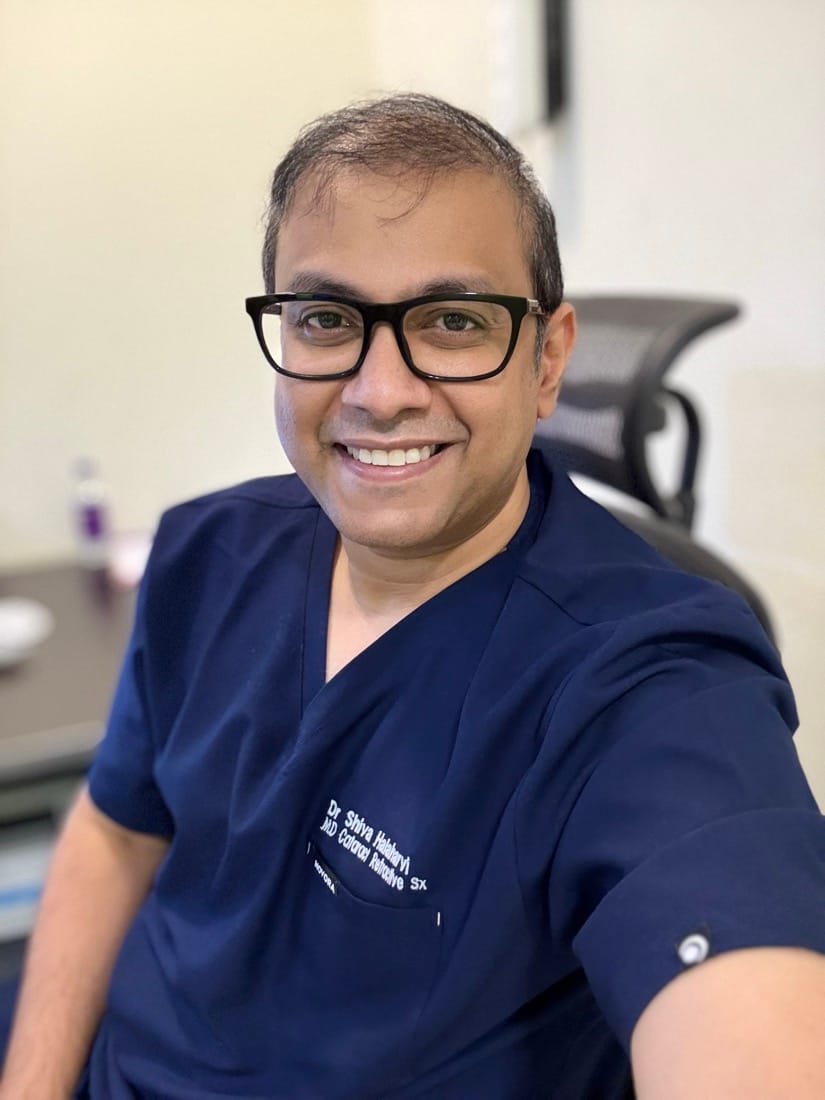
Third generation of a family Hyderabad has trusted with its eyes since 1975, founded by Padma Bhushan Dr. P. Siva Reddy, "the People's Ophthalmologist."
Usually the early-to-mid forties, and it keeps changing into the sixties. It happens to everyone, even people who have never needed glasses in their life. It is not a disease and not a sign that anything is wrong, just the eye's natural lens becoming less flexible with age.
The natural stiffening of the lens cannot be reversed, and we will be honest about that. But near vision can absolutely be restored, with the right glasses or contact lenses, or with lens-based surgery that gives back a fuller range of vision. 'Corrected' rather than 'cured' is the honest word.
Not necessarily. Many people reduce or remove the need with multifocal contact lenses, or with presbyopia-correcting lens implants, often chosen when a cataract is also starting. We will tell you honestly what is realistic for your particular eyes rather than promise a perfect result.
They are lenses that replace the eye's own lens and are designed to give a range of vision, near, intermediate and distance, so you depend far less on glasses. They are most often chosen at the time of cataract surgery, so one procedure addresses both. We explain the trade-offs, including night-time glare, openly. See our cataract page for how the lens choice works.
No, but they affect the same lens at different stages. Presbyopia is the lens stiffening, so near focus fades; a cataract is the same lens clouding, so vision dims. Many people develop both, which is exactly why the timing of treatment matters and why we look at the whole picture.
It depends entirely on the route you choose, from simple glasses to lens-based surgery, which the doctor explains clearly once your eyes have been examined and your daily vision needs understood. The honest way to know is the consultation. You are welcome in Himayat Nagar; book on WhatsApp or by phone.
Book on WhatsApp or by phone, and bring your current glasses and any recent prescription so we can see where you are starting from.
Medically reviewed by Dr. H. Siva Mohan Reddy · 2026-06-25
The fastest way to reach us is WhatsApp. We typically respond the same day.