ICL is often right when…
Your power is high, your corneas are thin, borderline or irregular, your eyes lean dry, or you were told laser isn't for you. You also value that it's reversible.
If your glasses are strong, the usual question isn't just 'LASIK or not' — it's whether laser can safely correct that much power at all. For high short-sight, an implanted ICL lens is often the better, safer answer. Here's the honest comparison, and how we decide for your eyes.
The higher your short-sight, the more corneal tissue LASIK must remove to flatten the curve, and every cornea has a floor it shouldn't go below. Beyond a certain power, removing enough tissue would leave the cornea too thin to be safe. That's the point where ICL, which touches no corneal tissue, usually becomes the wiser route.
An honest, like-for-like look at the two for strong short-sight specifically.
| ICL | LASIK | |
|---|---|---|
| How it corrects | Adds a soft lens inside the eye | Removes corneal tissue to reshape |
| High power range | Handles high short-sight well | Limited by safe corneal thickness |
| Thin / borderline cornea | No tissue removed, fine | Often rules laser out |
| Reversible | Yes, lens can be removed | No, permanent reshaping |
| Dry-eye tendency | Minimal, no corneal nerves cut | Can be more at first, then settles |
| Recovery | Often a day or two | Quick, within days |
| At PSR | In-house | In-house |
Scroll the table sideways if needed →
At many busy centres, one person consults you, another operates, and a third sees you afterwards. Here, the same senior surgeon stays with you through your vision correction, and every visit after.
Your sight is not where to bargain-hunt. Ask these of any practice you are considering:
At Dr. P. Siva Reddy Eye Hospital, the answer to every one of these is yes.
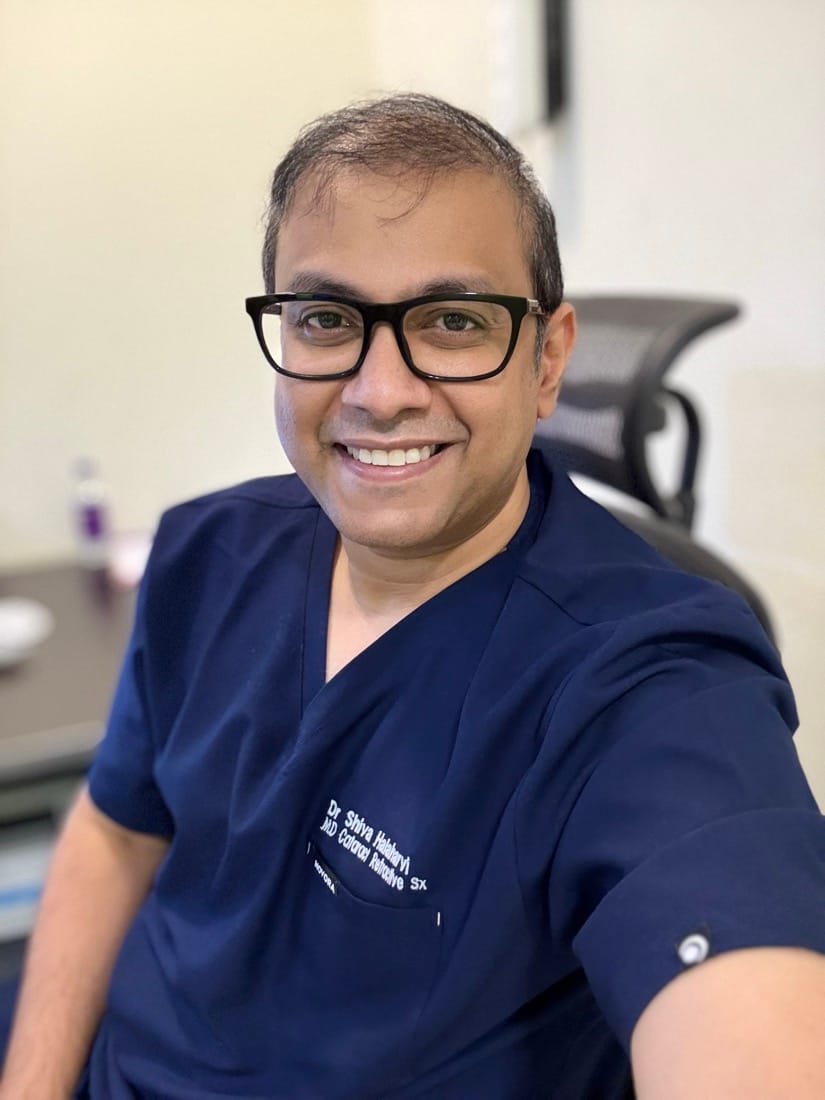
Third generation of a family Hyderabad has trusted with its eyes since 1975, founded by Padma Bhushan Dr. P. Siva Reddy, "the People's Ophthalmologist."
For genuinely high short-sight, ICL is often the better and safer answer, because it adds a lens inside the eye rather than removing corneal tissue. LASIK corrects by reshaping the cornea, and there's a limit to how much tissue can be safely removed before the cornea is left too thin. Beyond a certain power, ICL frequently becomes the honest choice. But the only way to know for your eyes is to measure them.
Loosely, short-sight beyond about -6.00 dioptres is often called high myopia, and beyond roughly -8.00 to -10.00 it becomes very high. There's no single hard cut-off where LASIK stops and ICL starts, because it also depends on your corneal thickness and shape. A thin cornea can rule laser out at a lower power; a thick, healthy one may allow it a little higher. The scan decides, not the label.
LASIK works by removing a small amount of corneal tissue to flatten the curve. The higher your power, the more tissue must be removed, and every cornea has a safe limit below which it shouldn't be thinned. Pushing laser beyond that risks weakening the cornea (ectasia). For high powers, ICL sidesteps this entirely by leaving the cornea untouched.
Yes, in suitable eyes it's a well-established, reversible option. The ICL is a soft, biocompatible lens placed inside the eye in front of your natural lens. Because it removes no corneal tissue, it's especially suited to high powers and to thin or borderline corneas. As with any procedure, suitability depends on the space inside your eye and a full assessment, which we do before recommending it.
Yes. Unlike laser, which permanently reshapes the cornea, the ICL can be removed or exchanged if ever needed. For a young person with high myopia making a long-term decision, that reversibility is a genuine advantage, and one reason many prefer it.
Possibly. A thick, healthy, regular cornea may allow laser to correct a higher power safely than a thin one would. This is exactly why we don't decide from the glasses number alone. We measure corneal thickness and shape, then tell you honestly whether laser is safe for your eyes or whether ICL is the wiser route.
It depends on your eyes and which option genuinely suits them, which we only know after measuring. We'd rather discuss cost properly at your assessment than publish a figure that misleads. Vision-correction procedures are elective and usually not covered by insurance; we'll explain everything clearly. You're welcome in Himayat Nagar; book on WhatsApp or by phone.
One refractive suitability assessment measures your prescription, corneal thickness and shape, and the space inside your eye, everything needed to tell you whether ICL, LASIK, or neither is right. The same surgeon who advises you is the one who would perform it. Sometimes the honest answer is that one eye suits laser and the other suits ICL, and we'll tell you that too.
Medically reviewed by Dr. H. Siva Mohan Reddy · 2026-06-26
The fastest way to reach us is WhatsApp. We typically respond the same day.